DIDYMOS
Up-to-date without update – Soft relaunch, focus on essentials


At a glance
Initial situation: The online shop of DIDYMOS has been running on a Shopware version since 2021 that is no longer being developed. An update became more complex and expensive with each passing year.
Solution: Instead of a classic update, we recommended a soft relaunch: a new shop at the current state, with all customers, orders, and products, but only with the functions that DIDYMOS truly needs.
Result: Since March 2026, the shop has been up to date, with a new design and reorganized content. Future updates will be simpler with fewer extensions: We already implemented a major version jump during the project in less than a day.
During the preliminary work for the soft relaunch, von Affenfels supported us with their usual reliability and helped us achieve a new look and modern technology while keeping costs in mind.

Tina Hoffmann
Managing Director
DIDYMOS Erika Hoffmann GmbH
Profile

Customer
Partner since
2015, back then with an OXID shopProject
Soft relaunch on Shopware 6.7 with data transfer and new servers, go-live in March 2026.Technical Setup
Shopware 6.7, OpenSearch, Cloudinary, Mollie, PayPal, HetznerServices
Consulting, architecture, data migration, theme selection and customization, custom developments, hosting & operation
Initial situation
DIDYMOS, manufacturer and seller of sustainable wraps and baby carriers, has been working with us since 2015. In September 2021, we migrated the OXID shop to Shopware 6.
Shopware 6 was still a young shop system back then. Each new major version brought significant changes with it. At the same time, we had to supplement many functions through our own customizations or third-party plugins. Both made an update with each released version more labor-intensive and complex. Because the timing was never right, the shop remained on the Shopware version from 2021. What was due as a major version eventually became three over time.
Goals

Currently
Bring the shop to the current Shopware version – as a basis for security updates, new features, and plugin updates.Slim
Only keep functions and adjustments that are still needed today.Complete
Transfer all existing products, orders, customers, content, and marketing actions.Economic
Stay within the existing budget with as little effort as possible.Updatable
Future updates can be implemented without a major project of our own.
Challenges
Three version jumps meant significant changes in both breadth and depth: almost every area of the shop would have been affected by an update. At the same time, it was clear that some adjustments and functions were no longer needed. A restructuring of these now superfluous functions would have incurred costs without benefits – and was therefore out of the question.
- Plugin compatibility
Not every third-party plugin has a version for Shopware 6.7 – some are no longer needed because the Shopware standard now covers their functions. - Dependency between server and shop
The operating system and PHP on the old server were outdated and no longer received security updates in part. However, the server could only be updated together with the shop: the installed Shopware version did not run on newer PHP versions, but newer Shopware versions require these. - Ongoing operation
While we were working on the new shop, there was of course constant activity in the old live shop: new customers, new orders, new products. For the go-live, we had to merge the two data states – and that within the shortest possible maintenance window.
Solution concept
Follow-up effort as a measure
In joint workshops, we thoroughly examined the shop with DIDYMOS and weighed the cost of each function today against the effort it would require for future updates. More often than not, DIDYMOS opted for the Shopware standard, even if this sometimes meant forgoing detailed features.Reinstall, transfer data
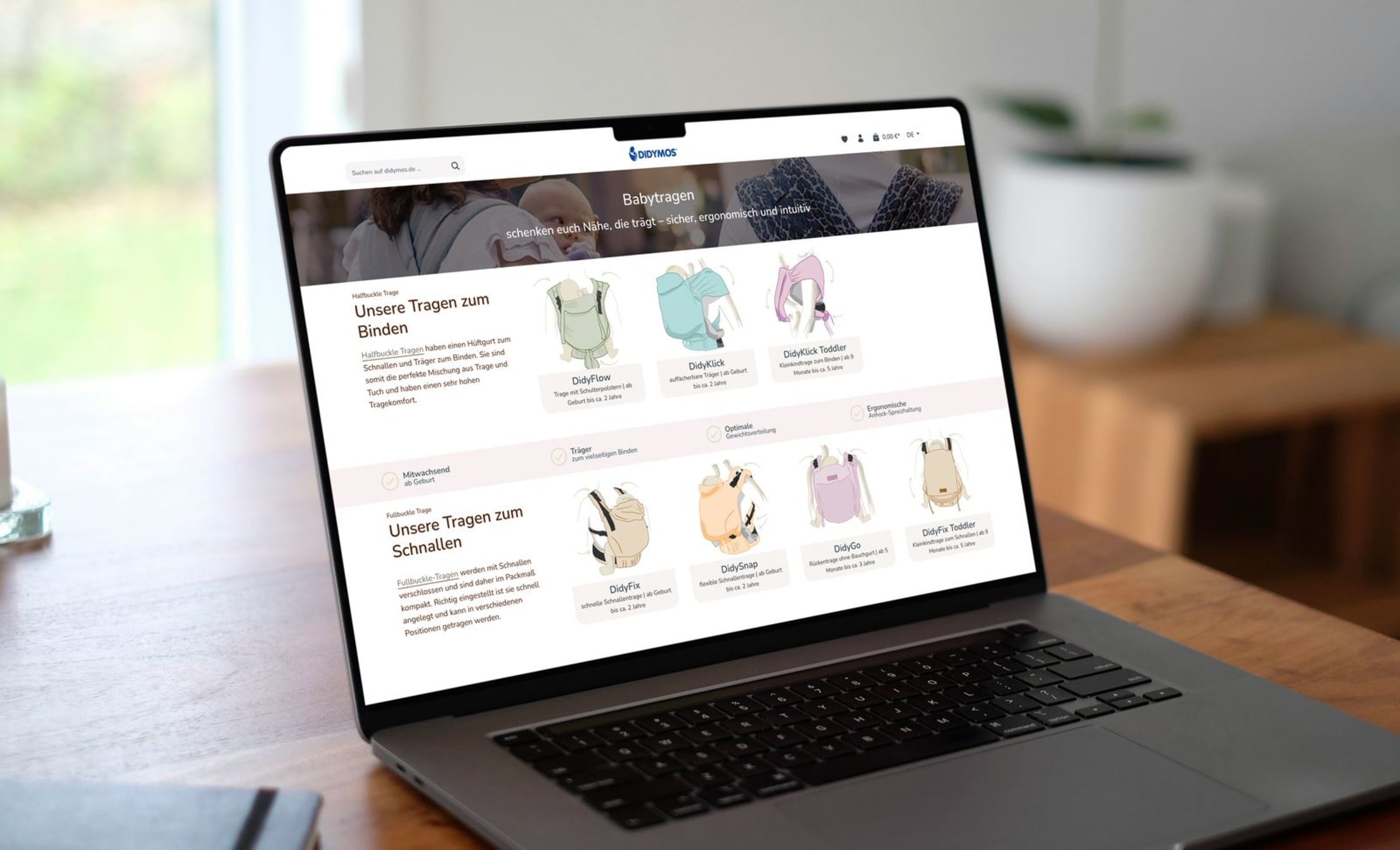
We have freshly installed Shopware 6.7 and imported the migrated live database: over 50,000 orders, 45,000 customers, and 14,000 articles including variants, as well as content and marketing campaigns.Purchase theme as a basis
At our recommendation, the shop is based on the Horizon theme from zenit. We have implemented the DIDYMOS-specific adjustments in a derived theme to ensure that the base theme remains updatable.
Why a purchase theme
What is truly important, we weighed together with DIDYMOS based on four options:
Option | Assessment |
|---|---|
Update existing theme | Shopware 6.5 has replaced Bootstrap 4, the technical framework of the design, with Bootstrap 5. We would have had to rewrite the theme in large parts. |
Own Redesign | High effort for concept, design, and implementation; a lot of our own template code that we would have to check with each update. |
Shopware standard theme with CI adjustments | Affordable and update-proof, but without its own identity: The shop would have looked like many other Shopware shops. |
Purchase theme with custom adjustments | The theme is maintained by the manufacturer for new Shopware versions, offers many design options, and is relatively inexpensive. |
We have jointly decided on a purchase theme: Less custom template code means less effort for future updates – and lower implementation costs.
For this, DIDYMOS accepts two things: Third-party plugins are technically not always compatible with the theme, which still requires adjustments by us. Additionally, the many design options of the theme require more experience in maintenance than custom content elements. Thus, part of the effort shifts from development to maintenance – this part DIDYMOS consciously wanted to take on itself.
Workflow
The live operation of the existing shop had to be ensured. Therefore, we set up the new shop in its own test environment, separate from the live shop and the regular staging environment. There, DIDYMOS tested, revised the content in large parts, and restructured the categories. The new theme made the revision necessary anyway, and a reorganization of the categories had been planned for some time.
We completely simulated the merging of the two data sets in a trial run before the Go-Live. What was still missing was included in the Go-Live plan, ensuring that the actual Go-Live went more smoothly. A maintenance window of three hours was necessary because we had to migrate the database tables related to orders and customers to the current state.
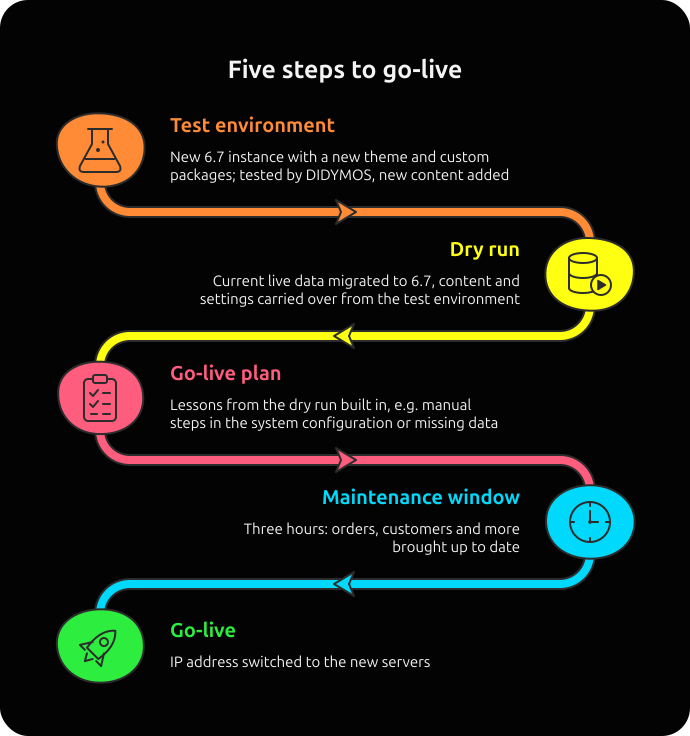
The old shop remained accessible under its own address until June 2026 after the Go-Live. This allowed DIDYMOS to continue viewing old content that had already been overwritten in the new shop and to adopt it if necessary.
Implementation
- Everything reassessed
We did not adopt 16 plugins; functions such as the notification for availability are now covered by our in-house extension packages. This also reduces ongoing costs. - Images via Cloudinary
SEO tools have repeatedly criticized oversized images, which is why DIDYMOS desired a solution. Through our in-house Cloudinary integration, the shop now delivers each image directly in the appropriate format and size for screen and browser upon request. Instead of JPGs and PNGs, modern image formats are automatically used, which are smaller and comparably sharp. The goal is shorter loading times, which also benefit visibility in search engines. - Bundled color variants
Until now, each color was a separate item; now the colors are variants of a main item. To ensure that search engines still index the correct page, canonical tags establish the definitive URL. - Accessibility and Data Protection
With 6.7, the accessibility improvements of the Shopware standard are active in the shop. Forms are protected by the Captcha Altcha, which does not rely on third-party services.


Result
What DIDYMOS has today
Since March 2026, the shop has been running on the current Shopware version, on new servers, with newly structured content and categories, as well as automatically optimized images. All customers, orders, and products from the old shop have been transferred. We are implementing further topics directly in the new shop, such as the integration of a fulfillment service provider.
Why future updates are easier
Security updates and new Shopware features can now be implemented again without a major project of our own. How well this works was already demonstrated during the project: When we raised the target version by a significant version jump in January 2026, the effort required was under a day. This is mainly due to the fact that there is less custom code in the shop. The theme is maintained by the manufacturer, so during an update, we only need to check the theme update and our adjustments to it. And with fewer third-party plugins, there are fewer dependencies and points where an update can disrupt our own customizations.
What we take with us
The actual development only took about two months. However, with the purchase theme, the effort shifted: away from development and towards content maintenance, which DIDYMOS took over itself. This accounted for the majority of the time until the go-live. For future projects, we will take away the lesson to show early on how much maintenance a purchase theme requires, so that time and support can be planned from the beginning. In the same project framework, DIDYMOS also received a newer Shopware version than originally planned. Additionally, new design, reorganized content, and new servers came together in one project, resulting in lower follow-up costs for each future update.
Milestones
July 2015
September 2021
October 2022
March 2023
March 2026
Technical Setup






Frequently Asked Questions
What is a soft relaunch of an online shop?
The shop is rebuilt on current software, while customers, orders, products and page URLs stay as they are. Design and content are revised without creating a completely new concept. For customers, the shop still feels familiar, and technically it is up to date again.
When does a soft relaunch make more sense than a Shopware update?
Mainly when many customizations are no longer needed or are due to be built differently anyway. With an update, everything that is no longer needed would first have to be painstakingly removed, and everything else updated one version at a time. With a soft relaunch, what isn’t needed is simply left behind. Other signs: the shop is several major versions behind, plugins have no current version, or the server needs replacing anyway. It pays to compare both routes before the project starts.
How long is an online shop offline when it moves to a new Shopware version?
That depends mainly on the amount of data. For DIDYMOS, with more than 50,000 orders, it was three hours. A trial run with real live data shows the duration in advance and reveals any missing steps.
How much time should you plan for revising the content?
More than people often expect: with a new theme, the home page, categories and content pages are rebuilt. In the DIDYMOS project, the content work took longer than anything else. Time and support for it belong in the project plan from the start.
Do Google rankings survive a soft relaunch?
They can, as long as redirects and language links are part of the data migration. Every old URL has to point to the matching new one, and every language version has to know its counterparts in the other languages. For DIDYMOS, we carried over the redirects from the previous SEO plugin and set up the language links for all four languages from scratch.
Contact person

Florian Münch
Team Lead