Orchestration of touchpoints
For consistent customer experiences


Today, we naturally move between websites, apps, newsletters, social media, e-commerce, and service platforms. For companies, this means: Every single touchpoint must seamlessly match in language, design, and experience. Only then does a consistent customer experience emerge that strengthens brands and supports business goals such as increasing conversions or customer retention. With a MACH architecture (Microservices, API-first, Cloud-native, Headless), companies create the technological foundation to master this complexity: Systems are flexibly connected, data flows in real-time, and new channels can be quickly integrated. This makes the cross-channel orchestration of touchpoints not only possible but also scalable and future-proof.
What to consider in cross-channel communication
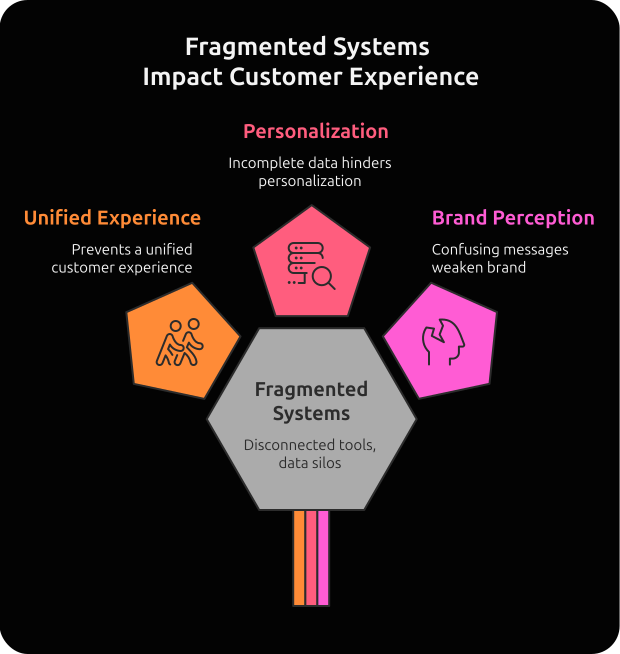
Fragmented system landscapes
Different tools for content, commerce, CRM, or marketing often lead to data silos and prevent a unified customer experience.
Quality and integration of data
Customer data is often incomplete or redundant. Without a clean data foundation, personalization is hardly feasible.
Consistency of the Customer Journey
Different messages, designs, or offers across channels confuse users and weaken brand perception.
Scalability and Performance
The more touchpoints are orchestrated, the more important speed, availability, and flexible system expansions become.
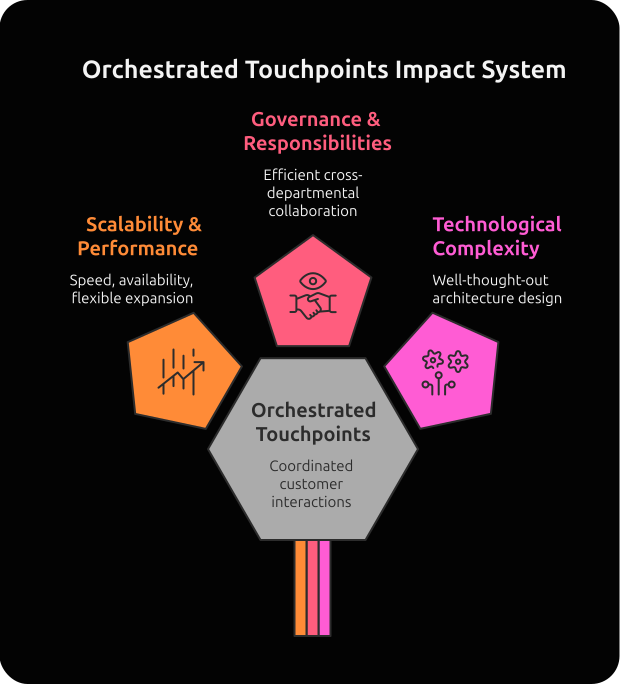
Governance & Responsibilities
Marketing, editorial, IT, and sales must work together efficiently – a lack of clarity in roles and processes quickly leads to friction losses.
Technological complexity
API-based integrations, microservices, and headless systems require a well-thought-out architecture design and continuous development.
Edited with AI

What we offer you
- Strategic Consulting & Goal DefinitionDevelopment of a clear omnichannel strategy with a focus on customer centricity; definition of measurable goals for customer experience, conversion, and brand perception.
- Data & System ArchitectureBuilding central data models (e.g., Customer Data Platform, content repositories); API-first integration of third-party providers and services in MACH environments
- Customer Journey & Touchpoint DesignAnalysis and visualization of the relevant touchpoints along the Customer Journey; development of consistent content and interaction patterns for all channels.
- Automation & AI-driven PersonalizationImplementation of intelligent recommendation systems and dynamic content delivery; use of AI for the automation of editorial workflows and campaign management.
- Governance & Change ManagementDefinition of clear roles, processes, and responsibilities between departments; support for teams in the implementation of new tools and working methods.
Frequently Asked Questions
What does touchpoint orchestration mean for consistent customer experiences?
Touchpoint orchestration refers to the coordinated management of all customer contact points across various channels. The goal is to harmonize messages, content, designs, and offers so that users have a consistent and coherent brand experience at every touchpoint.
What challenges exist in cross-channel communication?
The main challenges include fragmented system landscapes, incomplete or redundant customer data, inconsistent customer journeys, requirements for scalability and performance, as well as unclear responsibilities between Marketing, IT, Editorial, and Sales.
Why are data quality and system integration so important for omnichannel strategies?
Clean and integrated data are the foundation for personalization and consistent customer experiences. When data is siloed or erroneous, it becomes difficult to recognize customer needs and to deliver content effectively across all channels.
How can consistent Customer Journeys be implemented across multiple channels?
Consistent customer journeys arise from a clear omnichannel strategy, central data models, coordinated content and interaction patterns, as well as close collaboration among the involved teams. This ensures that communication, design, and offerings remain uniform across all channels.
What services support companies in touchpoint orchestration?
Important services include strategic consulting and goal definition, the establishment of a suitable data and system architecture, the analysis and design of the Customer Journey, automation and AI-supported personalization, as well as governance and change management for clear control of roles and processes.
Contact person

Philipp Kindermann
Team Lead